
How do property teams find water leaks before residents do?


6 min read
2 SmartHQ™ Leak Sensors kits compared
TL;DR
- Water damage leads multifamily insurance claims. In the NMHC 2023 State of Multifamily Risk Survey, 70.2% of respondents reported a water damage claim.
- Leaks often start at water heaters, supply lines, washers, toilets and HVAC condensate. Stacked units and vacant units raise the cost of a late find.
- EPA and CDC guidance is to dry wet materials within 24 to 48 hours to limit mold growth.
- Connected leak sensors alert maintenance at the spot where water collects. Pair them with meter checks, turnover inspections and a clear after-hours response plan.
In apartment buildings, a water leak often reaches the leasing office through a resident. A resident notices a stain on the ceiling, a soft spot in the carpet or a musty smell in a closet and calls the leasing office. By then the water has often been there for days, and it has had time to reach the subfloor, the drywall and the unit below.
This is not a failure of the maintenance team. Leaks tend to start in places no one checks on a normal day, such as water heater closets, sink cabinets, the space behind a washer and HVAC drain pans. A team that walks every unit every week would still miss most of them.
The question for property teams is not whether they can work harder to find leaks. It is whether they can learn about a leak at the spot where it starts, before a resident has a reason to call.
How much does water damage cost apartment buildings?
A single water damage claim can run from about $15,000 to more than $40,000. The Insurance Information Institute puts the average homeowners water damage and freezing claim at $15,400 for 2019 to 2023. Some commercial real estate portfolios average nearly $42,000 per water claim. An apartment building also has costs that never appear on the claim, such as the deductible, lost rent on a down unit and the unit below.
For a property manager, the restoration invoice is only part of the bill. Water damage is also the claim type multifamily operators report most often. In the NMHC 2023 State of Multifamily Risk Survey, 70.2% of respondents had filed a water damage claim in the prior year, ahead of liability and fire. The same survey found property insurance costs up an average of 26% year over year, and 61% of respondents had raised deductibles over the prior three years to keep coverage affordable. With higher deductibles, more water losses are paid directly from the property's operating budget.

Tip: Ask your insurance broker what your current water deductible is and how many water losses the property paid for itself last year. That number shows what late leak finds already cost you.
The biggest factor in that cost is how long the water sits before someone finds it. A leak found while it's still on the closet floor is a cleanup. Found days later, it becomes drywall, flooring, a second unit and a claim that lands inside your deductible.
Where do leaks start in apartment buildings?
Supply lines, toilet supplies, dishwasher connections and HVAC condensate lines fail in the same quiet places. Closets, cabinets and mechanical rooms do not get daily eyes. In a stacked building, a slow leak in an upstairs closet can reach the unit below before anyone upstairs notices a problem.
Rank units by water heater age, laundry location, vacancy and position above other units. Place coverage first where a late find creates two work orders.
Leaks in apartment buildings start where water equipment meets space nobody looks at, like water heater closets, sink cabinets, the space behind washers, toilet supply lines and HVAC drain pans. The equipment is rarely the surprise. What decides the damage is how long a small leak goes unnoticed.
Ask any maintenance supervisor where the last bad leak came from and they can name the closet. They know which buildings have the oldest water heaters, which floors have laundry stacked over living space, and which units have sat vacant since summer. The knowledge already lives on the team. It just isn't written down as a plan.
- Water heater closets are the classic source. The heater sits behind a door that stays closed for years, and the drain pan under it was meant to catch a small drip, not a failing tank. As a heater ages, the risk grows quietly. It's often found first by the resident in the unit below.
- Sink cabinets hide slow drips from supply lines, shutoff valves and drain connections. Residents store cleaning supplies in front of them and rarely look past the bottles. By the time someone notices, the cabinet floor has usually swollen or the flooring in front of it has started to lift.
- Washers and laundry closets carry the most water in the shortest time. A burst supply hose releases water fast, and when laundry sits on an upper floor, that water has an easy path to the ceiling below.
- Toilets and dishwashers fail in smaller ways that add up. A cracked supply line or a weeping connection under a dishwasher can run for weeks behind a kick plate or a vanity, out of sight from both the resident and the maintenance team.
- HVAC drain pans and condensate lines are the seasonal ones. They clog during cooling season, overflow into a mechanical closet, and soak the floor or ceiling around it, often in units the team only visits for filter changes.
Most properties still treat leaks as events, handled one call at a time. The teams that get ahead of water damage treat them as a map. They know which units carry the most risk, and why, before anything fails. A 12-year-old water heater in a second-floor closet above an occupied unit is a very different risk from a new one on a slab, even though both look identical on a unit inventory.
Tip: Sit down with your maintenance supervisor and list the ten units where a leak would hurt most. Think about older water heaters, laundry on upper floors, vacant units and anything stacked over another home. That list becomes your plan for inspections, replacements and where sensors go first.
How fast does a water leak cause damage?
The clock that matters to a site team is short. Water starts causing damage within hours, and mold can begin to grow within 24 to 48 hours if wet materials aren't dried. The U.S. Environmental Protection Agency advises drying water-damaged areas and items within 24 to 48 hours to help prevent mold growth. The Centers for Disease Control and Prevention gives the same window for cleaning, drying or removing wet items after water enters a building. For a property team, the clock starts when the leak starts, not when someone calls it in.
That gap is where most of the cost comes from. A leak that starts on a Friday evening in a closed closet has the whole weekend to work before anyone sees it. By Monday, the job has changed from a wet vac and a fan to tearing out materials.
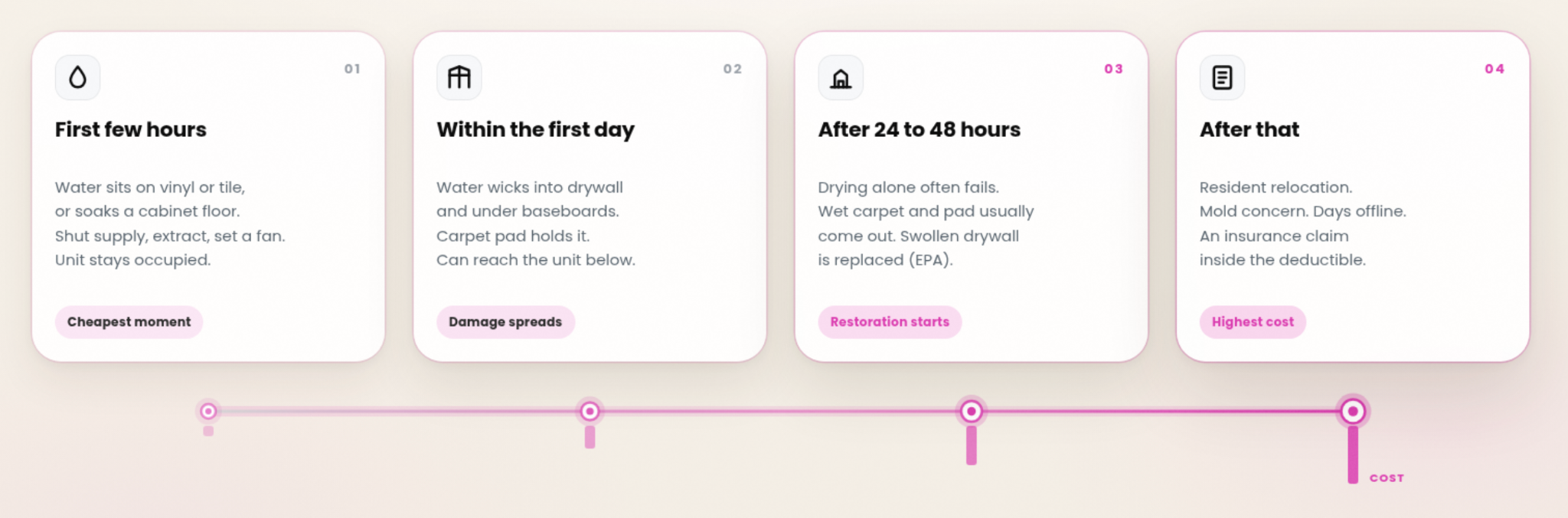
The first few hours are usually the cheapest moment in the life of a leak. Water sits on the surface of vinyl or tile, collects in the drain pan or soaks into the bottom of a cabinet. A technician can shut the supply, extract the water and set a fan, and the unit stays occupied.
Within the first day, water moves. It wicks into drywall at the base of the wall, seeps under baseboards and finds the seams in the subfloor. Carpet pad soaks it up and holds it. In a stacked building, this is when it reaches the ceiling below.
After 24 to 48 hours, drying alone often stops being enough. EPA remediation guidance notes that wet carpet and pad usually need to be removed, and drywall that has swollen or lost its seams usually needs to be replaced. Now the job involves a restoration vendor, a down unit and, often, a second unit.
After that, the cost includes things the team can't fix with tools. A resident may need to be relocated, mold remediation becomes a concern, the unit goes offline for days, and an insurance claim lands inside the deductible.
The response itself rarely decides how bad a leak gets. Most teams move fast once they know. What decides it is how many of those hours pass before anyone knows.
How do you detect water leaks in apartment buildings?
Apartment buildings detect water leaks by combining people, routine checks and connected leak sensors placed where leaks start. No single method sees everything. Inspections see a unit on the day someone is in it, meter checks see the building but not the source, and residents see the damage only after it reaches their space. Leak detection that works closes the time between those moments.
Detection in multifamily has always depended on someone happening to be in the right place. A tech on a filter change notices a damp cabinet. A leasing agent smells something in a vacant unit. A resident sees a stain overhead. Every one of those finds is real, and every one is a matter of luck. The leak was already there, waiting for someone to walk by.
The teams that stay ahead of water damage stop leaving that to chance. They decide ahead of time which spots get watched and how often, and who hears about it when something changes.
- Residents are the people in the unit every day, which makes them the best early warning a property has, as long as they know what to look for and reporting is easy. Most residents only call when the damage is visible. A short move-in note on where the water shutoff is and which signs to report, like a dripping supply line, a damp cabinet floor, a running toilet or a water heater that hisses or pools, makes them part of the plan instead of the backup. Make reporting simple too, through the resident portal or a direct maintenance line, so a small drip gets reported the day it's noticed instead of after it spreads.
- Inspections remain the foundation. Turnover walks and preventive maintenance visits are when a team catches the slow problems, like a rusting water heater base, a drain pan with standing water or a supply line starting to bulge. They work best with a short, consistent checklist for every water source in the unit, so nothing depends on what one technician happens to notice.
- Meter checks give the building-level view. When water use rises overnight with no clear reason, the team knows to start looking. They don't say where, but they're often the first sign of a leak hidden in a wall or under a slab.
- Connected leak sensors cover the time between visits, which is when most leaks actually start. Placed on the floor at the water heater, under sinks and behind washers, a sensor watches the one spot where water would collect first and alerts maintenance the moment it gets wet. The team learns about the leak at its source, with a unit and location attached, instead of through a call about the ceiling below.
Together, those layers change who finds the leak first. Right now, at most properties, the answer is whoever notices. A strong detection plan makes it the maintenance team, with residents as informed partners, while the leak is still small enough to be a cleanup.
Tip: For each high-risk unit, write down how a leak in its water heater closet would be found today, and how long that would take. If the honest answer is "when the unit below calls," that closet is the first place to add coverage.
How much do leak sensors cost?
The SmartHQ™ Leak Sensors comes in two kits. The 1-sensor kit (model SPLK10N01A) covers a single high-risk spot, such as a water heater closet. The 3-sensor kit (model SPLK30N01A) covers several spots in one unit or a mechanical room. Both include a gateway, and one gateway supports up to five sensors.
How should maintenance teams respond to leak alerts?
Respond to every leak alert as if water is spreading, because it usually is. A good response has a named owner, a clear first step and a target time. The team confirms the leak, stops the water, extracts it and documents the event, ideally within hours, not on the next business day. The teams that respond well decided all of this before the first alert came in.
An alert doesn't do anything until someone acts on it. Most response failures aren't about effort. They come from questions no one answered ahead of time. Who gets the alert at 6 p.m. on a Saturday? Does the on-call tech have a key to that unit? Where is the shutoff for that stack? When those answers live in one supervisor's head, every alert depends on that person picking up the phone.
Know who owns the alert. When a SmartHQ™ Leak Sensor detects water, it sends an alert by push notification, text or email. Decide who is on that list for each building, with a daytime owner and an after-hours owner, and include the supervisor so nothing quietly stalls. SmartHQ™ Management brings alerts from every sensor in the portfolio into one view, so the supervisor sees which property and unit triggered the alert without asking around.
Know the first fifteen minutes. The first person on site has three jobs. Confirm the source, stop the water at the fixture or the unit shutoff, and check the unit below. Because the sensor sits at the spot where the water started, the tech walks in knowing which closet or cabinet to open first.
Turn the alert into assigned work. An alert that sits in someone's phone is not a work order. With the 90-day free trial or a paid subscription, a supervisor can turn a leak alert into a task in SmartHQ™ Management, assign a technician, and set a priority and deadline. The technician gets a push notification, and the supervisor can see whether the job is moving. Tasks aren't assigned automatically, so the supervisor still decides who goes. The free Leak tier covers the alerts themselves, and teams on that tier handle follow-up in their existing work order system.
Know when to escalate. Most alerts end with a towel and a fan. Some don't. Agree in advance on when to call a restoration vendor, notify the resident in the unit below, or loop in the property manager and insurance broker. That way the tech on site isn't making that call alone.
Close the loop. Record every alert and its outcome, even a false alarm or a small drip. Over time, alert history across the portfolio shows which units, fixtures and buildings keep coming back. That tells you where to replace a water heater or a supply line before it fails again.
Tip: Before you install the first sensor, write a one-page leak response plan for each building. List who receives SmartHQ™ alerts during the day and after hours, every main and stack shutoff location, the restoration vendor's number and when to call them. Sensors find the leak early, and the plan makes sure someone acts on it.
What won't a leak sensor catch?
A leak sensor catches water at the spot where it sits, and nothing else. It won't detect a leak inside a wall, under a slab or in a ceiling until that water reaches the sensor. It doesn't sense humidity or condensation. It also needs a working network connection at the gateway to send alerts. Knowing those limits is what makes sensors useful, because it shows the team where its other habits still matter.
The most expensive leaks are often the ones no one can see. A pinhole leak in a supply line behind drywall can run for weeks. A slow drain leak under a tub soaks the subfloor long before it shows up anywhere. A sensor on the closet floor won't hear about either one. That isn't a flaw in the sensor. It shows that leak detection is a system, not a single device.
Sensors don't replace inspections. Turnover walks and preventive maintenance visits still catch the slow signs, like a rusting water heater base, a bulging supply hose or a stained cabinet floor, before anything reaches the floor.
Sensors don't replace equipment planning. A sensor tells you when a water heater has failed. A replacement schedule based on age and condition keeps it from failing in the first place. The same goes for washer hoses and toilet supply lines.
Sensors don't replace meter checks. A building-level meter read during a quiet period is still the best way to spot a hidden leak that no single sensor is near.
Sensors don't stop the water on their own. A SmartHQ™ Leak Sensor alerts your team, and someone still has to close the valve. Automatic shutoff requires a compatible GE or Profile smart water softener with the Remote Water Shutoff Valve (RMVALVESFT), or a GeoSpring water heater. For most properties, that makes shutoff locations and after-hours response part of the plan.
The teams that get the most from sensors use them for what they do best, which is early notice at the spots where leaks start. Inspections, meter checks and planned replacements cover the rest.
Water heaters, supply lines, washing machine hoses, toilets and HVAC drain pans cause most interior water damage in apartment buildings. They all sit in closets and cabinets that nobody checks every day. The age of the equipment and where it sits in the building, especially above another unit, decide how bad a failure gets.
Start with the units where a leak would cost the most. That means units with older water heaters, laundry on upper floors, units stacked above occupied homes, and vacant units with nobody inside to notice water. In each unit, put the sensor on the floor where water would collect first, beside the water heater, under the sink or behind the washer.
Yes, to send alerts remotely. Each SmartHQ™ Leak Sensor talks to its gateway over Bluetooth, and the gateway needs 2.4 GHz Wi-Fi for setup and for every push, text or email alert. Keep each sensor within about 130 feet of its gateway with no solid obstructions, and check the signal at the gateway before you leave the unit.
SmartHQ™ Leak Sensors run up to 3 years on two AAA batteries, which come pre-installed. Battery health shows in the SmartHQ™ Home app and SmartHQ™ Management. Adding a battery check to preventive maintenance visits keeps sensors from going quiet between visits.
No. SmartHQ™ Leak Sensors work with either the SmartHQ™ Home app or SmartHQ™ Management. For teams covering many units, SmartHQ™ Management brings every alert into one view. Its Leak tier is free with GE leak sensors and covers leak alerts. Turning an alert into an assigned task requires the 90-day free trial or a paid subscription.
No. Leak sensors trigger when liquid water reaches the sensor, not when humidity rises or a surface feels damp. Condensation and humidity problems call for a humidity meter and good ventilation. The EPA recommends keeping indoor humidity below 60 percent to help prevent mold.
They do different jobs. A meter check during a quiet period can show that a leak exists somewhere in the building, but only when someone runs it, and it doesn't show where. A leak sensor watches one spot and alerts the team the moment water reaches it. Use sensors at high-risk points and keep meter checks in the routine.
Yes. SmartHQ™ Leak Sensors don't connect to the plumbing, so the age of the pipes doesn't matter. A sensor sits on the floor or stands on edge wherever water would collect first, next to any brand of appliance or fixture. It needs to be in range of its gateway, with 2.4 GHz Wi-Fi where the gateway sits.
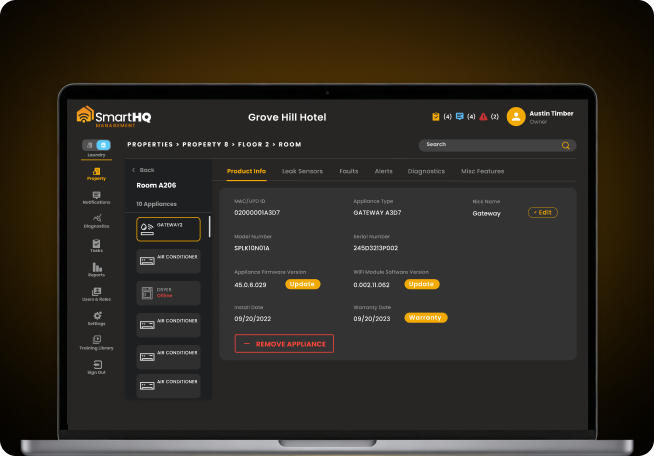
Still managing your entire appliance fleet without real-time visibility?
- Real-time monitoring and precision diagnostics across your portfolio
- Remote controls and batch commands without room-by-room visits
Portfolio-wide
appliance visibility
Real-time
monitoring & control